Say it once.
Then direct it.
Describe the video you want and the first take lands in about a minute, picture and sound together on whichever of 21 video models you pick. After that you stop prompting and start directing. One note at a time, each one a brand new take, with everything you already made still sitting right there.
Included with the Pro and Teams plans. No separate video subscription.
A note. A take. Nothing lost.
Give a note the way you would on a set. Director Mode shoots a new take that remembers the one before it. Change your mind and the take you liked is still right there, one click back.
Give it a note
Each note shoots a new take. The old ones stay exactly where they were.
Take thread
1 of 30Click any take to bring it back. Star the keeper so the cut knows which one you meant.
The rule of the room
Nothing you make is
ever overwritten.
Takes stack into a thread you can branch from, star, and come back to a week later. There is no undo to be afraid of, because there is nothing to undo.
Fast while you explore. Cinematic when it counts.
The tier is a per-take decision, not a plan you are locked into. Rough something out on the quick one, then shoot the keeper on the good one.
The one you explore in.
Try three versions of a shot before lunch. Flash is where you live while you are still working out what the video actually is.
- Clip length
- Around eight seconds
- Frame shapes
- 16:9 and 9:16
- References
- One opening frame
- Best for
- Drafts, tests, social cuts
Every model. One set.
21 video models from 11 labs, picked per take. Open the Model picker on any tier, read the spec sheet, and shoot the take on the model that suits the shot. The tier's built-in engine is always one tap away, and swapping models never changes how you direct.
Flash
7 models- Gemini OmniBuilt-in defaultGoogle DeepMind
The conversational default — direct changes in plain language and the shot stays the shot.
Up to 8s720pNative audioImage anchorEdits footage - Aleph 2.0Edits footage onlyRunway
Runway's video-editing flagship — hand it footage and direct the change.
Up to 30sSilent - Act-TwoEdits footage onlyRunway
Runway's performance-transfer model — your character performs the footage's exact delivery.
Up to 30sSilentImage anchor - Kling 2.5 TurboKuaishou
Crisp, energetic motion at turbo speed.
Up to 10sSilentImage anchor - Hailuo 2.3 FastMiniMax
Lifelike motion from a single frame, fast.
Up to 10s768pSilentImage anchor - LTX 2.3 FastLightricks
High-resolution drafts on a budget — up to 20 seconds of 4K.
Up to 20s4KNative audioImage anchor - Pika 2.2Pika
Playful, stylized five-second shots.
Up to 5s1080pSilentImage anchor
Cinema Lite
1 model- Seedance 2.0 MiniBuilt-in defaultByteDance
The Cinema Lite default — the Seedance family's draft tier, about half the credits.
Up to 15s720pNative audioImage anchorEdits footage
Cinema
10 models- Seedance 2.0Built-in defaultByteDance
The Cinema default — premium fidelity, footage-anchored edits, native audio.
Up to 15s4KNative audioImage anchorEdits footage - Kling 2.6 ProKuaishou
Cinematic motion with a director's eye for camera moves.
Up to 10sSilentImage anchor - Kling 3.0 ProKuaishou
Kling's flagship — multi-shot direction with native audio, up to 15 seconds.
Up to 15sNative audioImage anchor - Hailuo 2.3 ProMiniMax
Best-in-class physics and human motion at 1080p.
Up to 10s1080pSilentImage anchor - MiniMax H3MiniMax
MiniMax's arena heavyweight — native audio up to 4K.
Up to 15s4KNative audioImage anchor - Veo 3.1Google DeepMind
Google's flagship — native audio and razor prompt adherence.
Up to 8s1080pNative audioImage anchor - Sora 2OpenAI
Native sound and sharp storytelling instincts.
Up to 12s720pNative audioImage anchor - Grok Imagine 1.5xAI
xAI's fast cinematic engine — lip-synced dialogue on a budget.
Up to 15s1080pNative audioImage anchor - Happy Horse 1.1Alibaba
Alibaba's arena climber — lip-synced dialogue in seven languages.
Up to 15s1080pNative audioImage anchor - LTX 2.3 ProLightricks
Open-source cinema — 4K-capable takes at the lowest premium price.
Up to 10s4KNative audioImage anchor
Cinema Ultra
3 models- Seedance 2.5Built-in defaultByteDance
The Cinema Ultra default — up to 30 seconds in one continuous take.
Up to 30s1080pNative audioImage anchorEdits footage - Sora 2 ProOpenAI
OpenAI's premium cut — longer, steadier, cinema-ready takes with native sound.
Up to 20s720pNative audioImage anchor - FLUX 3Black Forest Labs
Black Forest Labs' video flagship — 20-second sound-designed takes.
Up to 20s1080pNative audioImage anchor
Names and marks belong to their labs. This roster mirrors the studio's live Model picker, so it changes as models ship.
The production
Build it scene by scene.
Open the next moment and it picks up exactly where the last scene's chosen take left off. Same world, same cast, next beat. Star a keeper in each scene, then play the whole thing through as one film or hand it to Final Cut.
- Up to two hundred scenes in a single production.
- Every scene keeps its own take thread, so a rework never touches the rest.
- Reorder scenes on a timeline and trim, crop, or resize any clip in place.
Capture a face once. Keep it for the whole film.
Pause any take, draw a box around whoever deserves an encore, and they join your library as exact pixels. A full turnaround comes with them, so they hold their look from every angle in every scene you stage them into.
Turnaround sheet
Video models to pick from
AI labs on one set
Scenes in one production
Takes per scene
Angles per cast member
In a single unbroken take
Everything a shot might need, one tap away.
Pick the model per take
Every tier opens a Model picker of 21 video models with a spec sheet and warnings against what you have staged. Each take renders on the one you chose, and the built-in default is always one tap away.
Start from your own pixels
Attach a photo as the opening frame, or a stack of references so the shot is built from the exact look you already have. Up to thirty on the top tier.
Lighting you pick by looking
Sixteen setups, each one photographed on the same stand-in so you choose a look by seeing it rather than by reading its name.
Bring your own footage
Upload a clip you already shot and direct it the same way. Every note becomes a new take, and the original is never touched.
Story Mode
Describe a film once. You get a cast, a style register, and a shot list you can edit, then roll the whole thing shot by shot.
Lyric videos
Upload your song and the words land on the picture in time with it, in a look you pick from a shelf of eighteen.
An audio desk
Score, voice, effects, and per-scene levels on one timeline, with ducking under narration so nothing fights the words.
Final Cut
Every starred take assembled into one film with transitions, narration, and a soundtrack, ready to download.
Perform
Attach an audio track and the person on screen performs it, or point it at footage you already have and re-voice that instead.
Six frame shapes
From 21:9 to 9:16, picked once for the production so every scene cuts together instead of fighting the format.
Four moves, start to finish.
Describe it
Type the video you want and hit send. Attach a photo if the shot should start from something real. Take one lands in about a minute.
Direct it
One note at a time. Warmer light. Make it rain. Every note is a new take that remembers the last, and the thread keeps all of them.
Assemble it
Star the keeper, open the next scene, and keep going. Each scene continues from the take you chose in the one before it.
Cut it
Trim, score, narrate, and export the whole production as one film. Or grab the scenes in order and cut it somewhere else.
Same models. A different way to work.
Runway, Higgsfield, and 8frame put many video models behind one subscription too. The difference is what happens after the first render.
And in chat
Not every video needs a whole studio.
Ask Theo for a clip in an ordinary conversation and it renders right there in the thread. When the idea turns out to be bigger than one shot, carry the prompt straight into Director Mode and keep going.
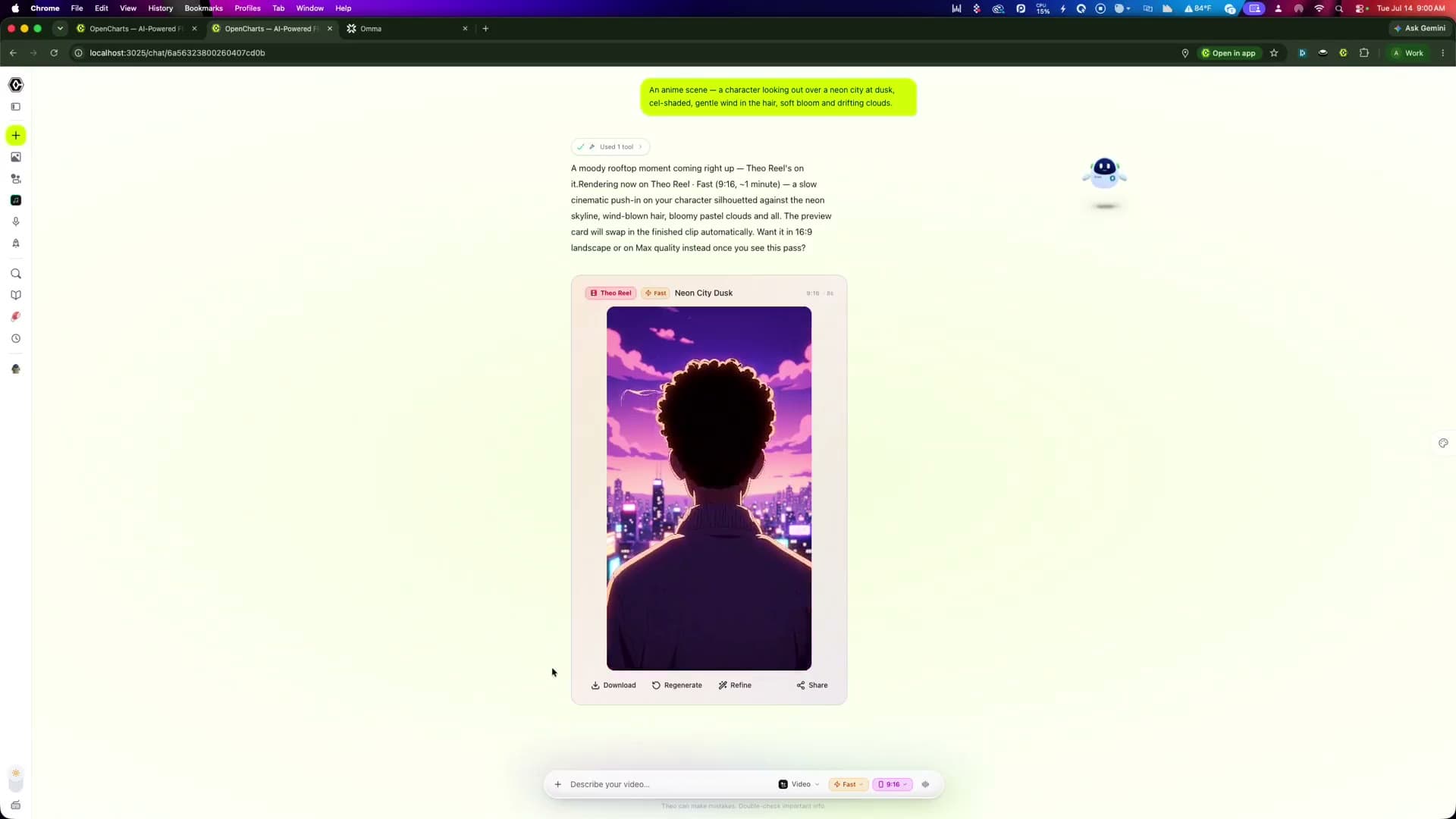 Video in chat
Free · No sign-in · Always on
See it running, 24 hours a day.
OpenCharts TV is fifteen channels of never-ending video, every clip made in seconds with Director Mode. Tune in, switch between Shuffle and Story, and when a scene grabs you, remix it in the studio.
- 01CommercialsBrought to you by nobody.
- 02KidsGentle worlds, big hearts.
- 03Deep FieldTransmissions from the far edge.
- 04WildThe planet, up close.
- 05MidnightRain, neon, and unanswered questions.
- 06Channel ∞Anything. From anywhere.
- 07RetroTelevision from a living room that no longer exists.
- 08ComedyOne joke. Ten seconds. Full commitment.
- 09CookingRecipes from every dimension.
- 10Rest & RelaxationClose your eyes. Or don't.
- 11Backgrounds & MusicSomewhere calm, all day.
- 12PodcastTwo mics. Zero facts.
- 13TerrifyingDo not watch alone.
- 14LovePoetry you can see.
- 15SportsAll the coverage. None of the sports.
The things people ask.
What is Director Mode?
Which AI video models does Director Mode support?
Can I switch models per take?
How is that different from writing a better prompt?
Can I keep the same character across scenes?
Can I make a whole film, not just one clip?
Can I direct footage I already shot?
How is Director Mode different from Runway, Higgsfield, or 8frame?
What does it cost?

Step onto the set
Describe a video, watch it roll, then direct it take by take. Included with Pro and Teams, and nothing you make is ever overwritten.